What to do in Saint-Malo

HIGHEST TIDES IN EUROPE

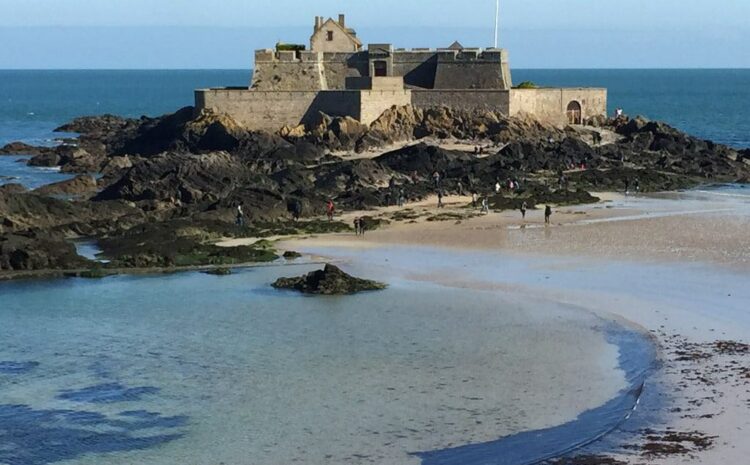
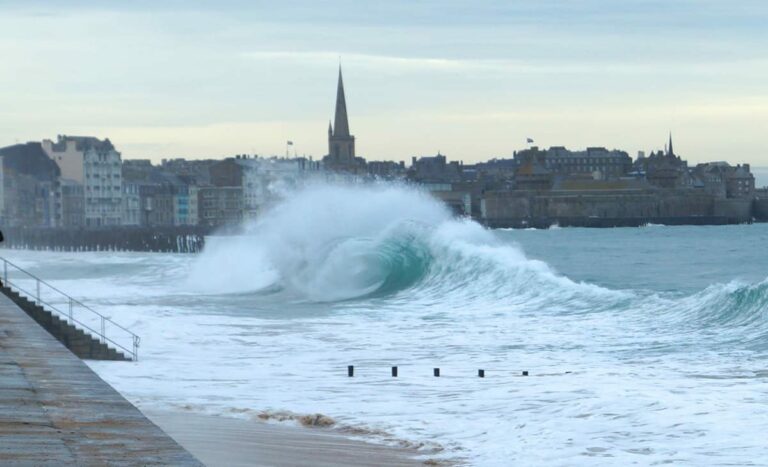
Saint-Malo has highest tides in Europe, and during GSI’23, we will have highest 2023 Saint-Malo tides of the year with a tide coefficient of 112 (13,33 meters of marling): https://www.youtube.com/watch?v=JMyXCJ1Z7LA

You will attend the 1st lodges for these highest tides of the year from the “Palais du Grand Large” GSI’23 conference center. For people staying during the week-end, they could see highest 2023 tides at Mont-Saint-Michel (45 minutes from Saint-Malo) or visit Dinard (just in front of Saint-Malo) and French Britany Emeraude coast.

Enjoy French Brittany.

SOME OTHER COOL THINGS TO DO

Authors instructions

GSI'23 Geometric Science of Information, 30th August - September 1st 2023 Saint Malo, France

Important dates and information :

  • CMT (Microsoft Research) opening: January 15th
  • Deadline for 8 pages SPRINGER LNCS format: CLOSED
  • Notification of acceptance: April 28th, 2023
  • Final paper submission: May 25th, 2023
  • Registration opening: May 11th, 2023
  •  Author registration price:
    • 580€ – conference + gala diner (vat. incl)
    • 500€ – conference only (vat. incl)
  •  Student author registration price:
      • 350€ – conference + gala diner (vat. incl)
      • 300€ – conference only (vat. incl)

Writing your paper

  • Language: English
  • Word processor: Microsoft Word or Latex
  • Paper template: Do not change font or font-size or leading (line spacing). Keep the size of the page to A4 (21 cm x 29.70 cm)
  • Author’s identification: include affiliations of all authors, and full address including e-mail of the corresponding author.
  • Length: Maximum 8 pages (including figures and bibliography) . DO NOT number your pages
  • Special characters: when inserting special characters in text use Insert Symbol (avoid code-numbers for the symbols).

Paper templates and instructions

Use the LaTeX2e Proceedings Templates  >> Download here

The LaTeX template is also available on Overleaf

Also use the Springer’s guidelines and technical instructions for submitting your papers and more specifically :

INSTRUCTIONS FOR ACCEPTED PAPERS ONCE YOU GET THE E-MAIL

Please kindly prepare your final camera-ready paper by taking into account the reviews available on CMT using the GSI23-CopyrightForm GSI23-CopyrightForm:

You are allowed up to ***10 pages***: That is, you may optimally use 2 extra pages since the 8-page submission.

Do not add new results but rather use the 2 extra pages to refine your explanations or enhance the style of your paper like for example using more centered math equations \[\] instead of inline equations $…$, etc.

Please submit your final camera ready paper on CMT by May 25th 2023 (anywhere on earth) as follows:

  • Name a directory with « GSI-« + your paper number and include all latex files (including macros, etc) and compiled pdf file.

The main file name of your LaTex or Word shall be « GSI-« + your paper number using 3 digits:

For example, paper number 8, 15, 110 shall be named GSI-008.tex, GSI-015.tex, GSI-110.tex, respectively, and put in a folder named GSI-008, GSI-015, GSI-110, respectively

  • Please fill and sign electronically the following LNCS copyright form (Springer Nature Licence to Publish).

Please be sure to fill in page 1 and 5 of the copyright form GSI23-CopyrightForm.docx Scan PDF of SIGNED copyright form in Copyright-GSI23-#PaperNumber.pdf

https://www.springer.com/gp/computer-science/lncs/conference-proceedings-guidelines

Beware that papers longer than 10 pages or not following the LNCS file format or paper missing the SIGNED copyright form will not be accepted in the proceedings.

You’ll also need to register to the conference starting MAY 11TH.

ABOUT GSI

Chairmen Welcome

Welcome to “Geometric Science of Information” 2023 Conference

On behalf of both the organizing and the scientific committees, it is our great pleasure to welcome all delegates, representatives and participants from around the world to the sixth International SEE conference on “Geometric Science of Information” (GSI’23), scheduled at the end of August 2023.


GSI’23 benefits from scientific sponsors and financial sponsors.

The 3-day conference is also organized in the frame of the relations set up between SEE and scientific institutions or academic laboratories such as Ecole Polytechnique, Ecole des Mines ParisTech, INRIA, CentraleSupélec, Institut Mathématique de Bordeaux, Sony Computer Science Laboratories.

The GSI conference cycle has been initiated by the Brillouin Seminar Team as soon as 2009. The GSI’23 event has been motivated in the continuity of first initiatives launched in 2013 (https://www.see.asso.fr/gsi2013) at Mines PatisTech, consolidated in 2015 (https://www.see.asso.fr/gsi2015) at Ecole Polytechnique and opened to new communities in 2017 (https://www.see.asso.fr/gsi2017) at Mines ParisTech in 2019 (https://www.see.asso.fr/gsi2019) at ENAC Toulouse and in 2023 at Paris Sorbonne. We mention that in 2011, we organized an indo-french workshop on “Matrix Information Geometry” that yielded an edited book in 2013, and in 2017, collaborate to CIRM seminar in Luminy TGSI’17 “Topoplogical & Geometrical Structures of Information” (http://forum.cs-dc.org/category/94/tgsi2017). Last GSI’21 Proceedings have been edited by SPRINGER in Lecture Notes (https://link.springer.com/book/10.1007/978-3-030-80209-7 )

GSI satellites event have been organized in 2019 and 2020 as, FGSI’19 “Foundation of Geometric Science of Information” in Montpellier and Les Houches Seminar SPIGL’20 “Joint Structures and Common Foundations of Statistical Physics, Information Geometry and Inference for Learning”  or MaxEnt’22.

The technical program of GSI’23 covers all the main topics and highlights in the domain of “Geometric Science of Information” including Information Geometry Manifolds of structured data/information and their advanced applications. This proceedings consists solely of original research papers that have been carefully peer-reviewed by two or three experts before, and revised before acceptance.
 

Historical background

As for the GSI’13, GSI’15, GSI’17, GSI’19 and GSI’21, GSI’23 addresses inter-relations between different mathematical domains like shape spaces (geometric statistics on manifolds and Lie groups, deformations in shape space etc.), probability/optimization & algorithms on manifolds (structured matrix manifold, structured data/Information etc.), relational and discrete metric spaces (graph metrics, distance geometry, relational analysis etc.), computational and Hessian information geometry, geometric structures in thermodynamics and statistical physics, algebraic/infinite dimensional/Banach information manifolds, divergence geometry, tensor-valued morphology, optimal transport theory, manifold & topology learning etc., and applications like geometries of audio-processing, inverse problems and signal/image processing. GSI’21 topics were enriched with contributions from Lie Group Machine Learning, Harmonic Analysis on Lie Groups, Geometric Deep Learning, Geometry of Hamiltonian Monte Carlo, Geometric & (Poly)Symplectic Integrators, Contact Geometry & Hamiltonian Control, Geometric and structure preserving discretizations, Probability Density Estimation & Sampling in High Dimension, Geometry of Graphs and Networks and Geometry in Neuroscience & Cognitive Sciences.
 
At the turn of the century, new and fruitful interactions were discovered between several branches of science: Information Science (information theory, digital communications, statistical signal processing,), Mathematics (group theory, geometry and topology, probability, statistics, sheaves theory etc.) and Physics (geometric mechanics, thermodynamics, statistical physics, quantum mechanics etc.). The GSI conference cycle is a tentative to discover joint mathematical structures to all these disciplines by elaboration of a “General Theory of Information” embracing physics science, information science, and cognitive science in a global scheme.
 

More in Frank Nielsen’s GSI pages : https://franknielsen.github.io/GSI/

Frédéric Barbaresco, Frank Nielsen
Aller au contenu principal